Where Bright Ideas
Come to Life!
Come to Life!
If you've ever opened a meter cupboard, peered into a garage, or had an electrician walk you round a commercial unit, you've probably seen a chunky grey or metal box mounted near the supply with a switch on the front. There's a fair chance that box was a switch fuse isolator. It's one of those pieces of kit that does a great deal of quiet, important work and gets almost no attention until something goes wrong.
This guide explains what a switch fuse isolator is, what it actually does, why electricians fit them, and where you're likely to find one. It's written for homeowners, landlords, business owners and facilities teams who want to understand their own installation a little better — not to turn you into an electrician, but to help you make sensible decisions and ask the right questions.
A quick note before we start: this is closely related to, but not the same as, the switched fused spurs and isolation switches we cover elsewhere in the Knowledge Centre. Those are small, local devices that isolate a single appliance — a boiler, an immersion heater, an extractor fan. A switch fuse isolator works on a much bigger scale, controlling and protecting whole sections of an installation. Think of the fused spur as the tap at your kitchen sink, and the switch fuse as the stopcock for an entire wing of the building.
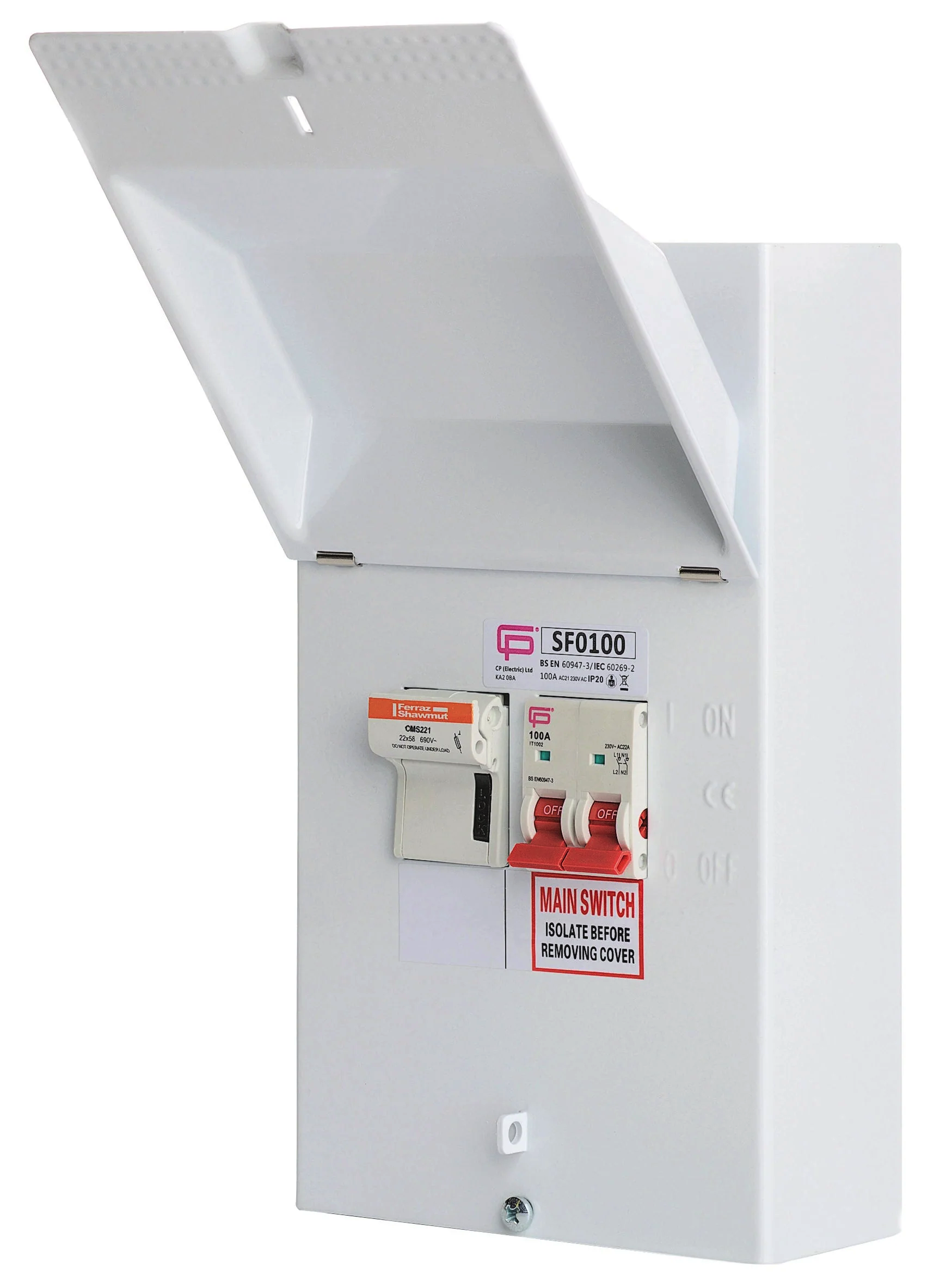
A switch fuse isolator does two jobs in a single enclosure.
The first job is isolation. It contains a switch — properly called a switch-disconnector — that lets you turn the supply to a circuit, a sub-main or a piece of equipment fully off. When that switch is open, no current can flow past it, which means whatever is downstream is safe to work on. That's the "isolator" part of the name.
The second job is protection. Built into the same unit are fuses — usually one per live conductor — that will blow and break the circuit automatically if too much current tries to pass through. That's the "fuse" part. Too much current means either an overload (more demand than the cable was designed for) or a fault (a short circuit or earth fault where current finds a path it shouldn't).
Put those two functions together and you have a device that can both be switched off by hand when you need it, and will switch itself off when something dangerous happens. One box, two safeguards. That combination is exactly why electricians reach for them.
Mechanically, the switch and the fuses are arranged so you can't get at the fuses while the unit is live. You switch off first, and only then can the fuse carriers be removed. That interlock is a deliberate safety feature, not an inconvenience.
This is an area where the names get muddled, even within the trade, so it's worth being precise.
A switch fuse is a switch with separate fuses downstream of it, all in one enclosure. The switch breaks the circuit; the fuses sit behind it and provide protection. You operate the switch, the fuses stay put.
A fuse switch (or fuse-switch-disconnector) is subtly different — here the fuse carriers themselves form the moving contacts of the switch. When you operate it, you're physically moving the fuses to make or break the circuit. You'll see these more often on larger commercial and industrial gear.
An isolator, strictly speaking, is just a switch-disconnector with no fuse at all. Its only job is to break the circuit so the bit beyond it is dead. A rotary isolator next to an air conditioning unit or an EV charger is a common example.
In everyday conversation — and in most product catalogues — "switch fuse isolator," "switch fuse unit" and "switchfuse" all tend to mean the same thing: a switch combined with fuses in one box. We'll use that everyday meaning throughout this guide, but it's helpful to know the distinctions exist, because they matter when an electrician specifies a particular unit for a particular purpose.
It's also worth separating all of this from the main switch inside your consumer unit (your fuse board). That main switch is usually a plain switch-disconnector with no fuse — the protection there comes from the individual MCBs, RCBOs or RCDs on each circuit. A switch fuse isolator is a step further back, often sitting between the meter and one or more consumer units, or feeding a completely separate part of the installation.
Everything a switch fuse does comes back to two principles that run right through BS 7671, the UK Wiring Regulations: you must be able to isolate parts of an installation safely, and every circuit must be protected against overcurrent.
BS 7671 (currently the 18th Edition) requires that every installation has a means of isolation, and that suitable isolation is available wherever someone might need to work on, replace or maintain equipment. Section 537, which deals with isolation and switching, is the part of the regulations that governs this.
The reason is straightforward. Before anyone touches a cable, a board or a fixed appliance, they need to be certain it's dead and that it can't be switched back on by someone else while they're working. A switch fuse isolator gives a clear, lockable, visible point to do exactly that. On many models you can fit a small padlock so the switch can't be flipped back on accidentally — invaluable when an electrician is working at one end of a building and the switch is at the other.
If you've read our piece on the safe isolation procedure, you'll know that "proving dead" is a non-negotiable step. A well-placed switch fuse makes that procedure quicker, safer and far less disruptive, because you can kill the supply to one section without plunging the whole property into darkness.
The second reason is protection. Every cable has a limit to how much current it can carry safely before it overheats. Push more through it than it's rated for and the insulation degrades, which over time is a genuine fire risk. A fault — say a live conductor touching earth — can produce an enormous surge of current in a fraction of a second.
The fuses inside a switch fuse are sized to the cable and the load they protect. If current climbs beyond a safe level, the fuse element melts and breaks the circuit before the cable can be damaged. The fuses commonly used are HRC (High Rupturing Capacity) cartridge fuses made to BS 88. These are robust, predictable and able to safely interrupt very large fault currents — exactly what you want guarding a sub-main feeding half a building.
So the short answer to "why use one?" is this: a switch fuse isolator lets you isolate a meaningful chunk of an installation by hand for maintenance, and it protects the cable feeding that chunk from overload and fault automatically. It's a control point and a safety device rolled into one.
This is where it becomes practical. Once you know what to look for, you'll start spotting them. Here are the most common locations and applications we come across day to day across Tonbridge, Tunbridge Wells, Sevenoaks and Crowborough.
In some properties — particularly older ones, larger homes and many commercial premises — a switch fuse is fitted right at the origin, just after the meter, acting as the main switch and main protective device for the whole installation. It sits between the supplier's equipment and your consumer unit, giving you a single point to isolate everything beyond it.
It's worth distinguishing this from the DNO cut-out, the supplier's own fuse that sits between the incoming service cable and your meter. That cut-out fuse — usually rated 60A, 80A or 100A — is sealed and belongs to the network operator. You're not permitted to touch it. A switch fuse on the customer side of the meter is yours to operate and gives you accessible, lawful isolation that the sealed cut-out can't.
This is probably the most common domestic application, and one we install regularly. When you want to run a supply out to a detached garage, a garden office, a workshop, a summerhouse or an annexe, that supply is a sub-main — effectively a smaller installation hanging off the main one.
The supply for that outbuilding is usually tapped off the incoming tails using Henley blocks (those black connector blocks you'll see near the meter), and a switch fuse isolator is fitted to control and protect that new sub-main. It gives the outbuilding its own isolation point and its own overcurrent protection, sized for the cable running underground or overhead to it. If a fault develops in the garage, the switch fuse there should deal with it without taking out the rest of the house.
In larger homes, commercial units, retail premises and care homes, a single consumer unit often isn't enough. Power gets distributed to several smaller boards spread around the building — a board for the kitchen, one for the workshop, one for a particular floor or wing. Each of those sub-boards is typically fed and protected by a switch fuse.
The advantage for a business is obvious: you can isolate and work on one area without shutting the whole site down. For a care home in particular, where continuity of power matters enormously for residents, being able to take one section offline for testing or repair while everything else keeps running is not a luxury — it's essential.
In commercial and light-industrial settings — manufacturing units, storage facilities, workshops — fixed machinery often needs a local means of isolation so it can be safely worked on, serviced or shut down in an emergency. A switch fuse mounted adjacent to the machine provides that, while also protecting the supply cable to it. Anyone maintaining that equipment can isolate it on the spot and lock it off.
You'll also see switch fuses or rotary isolators used near rooftop plant, air handling units, commercial extraction, and sometimes as part of an EV charger installation where a dedicated isolating and protective device is needed close to the equipment.
If a section of an installation is large enough, far enough from the main board, or important enough to deserve its own isolation and its own protection, that's where a switch fuse isolator earns its place. Origin of supply, outbuildings, sub-boards and fixed plant are the four big ones.
Switch fuse isolators aren't one-size-fits-all. The right unit depends on the supply and the load.
Single phase or three phase. Most homes have a single-phase supply, so a single-phase switch fuse (live and neutral, with a fuse in the live) is the norm. Larger commercial and industrial premises often have a three-phase supply, in which case a three-phase-and-neutral (TPN) switch fuse is used, with a fuse in each of the three phases. Three-phase units are physically larger and feed correspondingly bigger loads.
Current rating. Common ratings include 20A, 32A, 63A, 80A and 100A. A domestic main switch fuse is frequently 80A or 100A; a sub-main to a modest garage might be 32A or 63A. The rating is chosen to match the cable size and the expected load — never plucked from the air. Undersize it and it'll nuisance-trip; oversize it and it won't protect the cable properly.
Fuse type. Inside, you'll almost always find HRC cartridge fuses to BS 88. These are sized in amps to suit the circuit and are designed to clear high fault currents safely. They're a replaceable consumable — if one blows, the underlying fault must be found and fixed before fitting a new fuse of the correct rating. Replacing a blown fuse without investigating why it blew is asking for trouble.
Enclosure. Units come in moulded insulated enclosures or metal-clad versions, with different ingress-protection (IP) ratings depending on where they're mounted. A switch fuse in a damp garage or an exposed location needs a more weather-resistant enclosure than one tucked inside a dry plant room.
People often assume a switch fuse and a consumer unit do the same thing. They don't, though they work together.
Your consumer unit distributes power to the final circuits in your home — the sockets, lights, cooker, shower and so on — and protects each of those circuits individually with MCBs, RCBOs or RCDs. It's the hub where the building's circuits begin.
A switch fuse isolator sits further upstream. It controls and protects the supply feeding into a consumer unit, or feeding a separate part of the installation. It deals in larger currents and bigger sections. You might have one switch fuse feeding the whole house consumer unit, and a second switch fuse tapping off to feed the garage's own little consumer unit.
It's also not the same as an RCD, which detects earth leakage to protect against electric shock, nor the same as an MCB, which is a resettable overcurrent device. A switch fuse uses fuses — once one operates, it's replaced rather than reset. Each device has its job, and a well-designed installation uses them together rather than relying on any one of them.
To make this concrete, here are situations where we'd specify a switch fuse isolator.
A homeowner in Crowborough wants power and lighting in a new detached garden studio. We tap a supply off the existing tails with Henley blocks, fit a switch fuse to protect and isolate the new sub-main, and run an armoured cable out to a small consumer unit in the studio. The studio now has its own isolation, its own protection, and a fault out there won't black out the house.
A landlord with a converted property in Tunbridge Wells has several flats fed from a single intake. Each flat's supply is controlled by a switch fuse, so an electrician carrying out an EICR on one flat can isolate it cleanly without disturbing the neighbours.
A small manufacturing business near Tonbridge has a three-phase supply feeding several machines and a couple of sub-boards. Three-phase switch fuses give each machine and each board its own isolation and protection, so maintenance on one line doesn't stop the whole floor.
A care home in Sevenoaks with its own maintenance team needs to test and service sections of the building in rotation. Switch fuses feeding the various sub-boards mean sections can be safely isolated for an EICR or remedial work while residents elsewhere keep heat, light and power.
A switch fuse isolator handles the full supply current to a significant part of an installation, and working on or near it means working close to potentially lethal energy levels — often on the supply side of the meter, where the cut-out fuse is the only thing upstream. This is not DIY territory and it's not work for an unqualified handyman.
Installation, alteration and inspection of switch fuse units should be carried out by a qualified, registered electrician who can size the device correctly, install it safely, test it properly and certify the work. Anything involving the supplier's tails or cut-out may also require coordination with the network operator.
If you've got a blown fuse in a switch fuse unit, a unit that's tripping or buzzing, or you're planning work that needs a new sub-main — to a garage, an extension, an outbuilding or a new sub-board — that's exactly the kind of job to bring to a professional. The fuse blowing is a symptom; the cause needs finding.
Is a switch fuse the same as an isolator? Not quite. An isolator only switches the supply off. A switch fuse switches it off and protects it with fuses. In everyday use, "switch fuse isolator" describes a unit that does both.
Can I reset a switch fuse like a trip switch? No. If a fuse inside has operated, it has melted and must be physically replaced with one of the correct rating — and the reason it blew must be found first. That's different from an MCB or RCD, which you reset by flicking it back on.
Why does my outbuilding have its own switch near the meter? That's almost certainly a switch fuse protecting and isolating the sub-main running out to it. It lets you isolate the outbuilding independently and protects the cable feeding it.
Should every house have one? Not necessarily. Many homes are perfectly well served by a consumer unit with a main switch and no separate switch fuse. They become relevant when you're feeding outbuildings, sub-boards, or larger or more complex installations.
Will an EICR check it? Yes. During an Electrical Installation Condition Report, the inspector will assess switch fuses along with the rest of the installation — checking ratings, condition, connections and suitability against BS 7671.
A switch fuse isolator is a single device that does two essential things: it lets you isolate a section of an installation safely by hand, and it protects the cable feeding that section against overload and fault. You'll find them at the origin of a supply, feeding garages and outbuildings, controlling sub-distribution boards, and isolating fixed machinery. They're sized carefully to the supply and the load, they use HRC fuses to BS 88, and they're a key part of meeting the isolation and protection requirements of BS 7671.
If you're planning work that involves a new supply to an outbuilding, a sub-board for an extension or commercial unit, or you simply want your existing installation checked over, Bright Spark Electrical Services covers Tonbridge, Tunbridge Wells, Sevenoaks, Crowborough and the surrounding area. Our NICEIC-registered electricians can specify, install, inspect and certify the work properly — and explain exactly what we've done and why.
To book a very helpfull & knowledgeable and qualified Bright Spark Electrical Engineer to carry out a Survey, and provide a Free of Charge Quotation, fill out our simple form to visit your home. click [Click this Link]
For further Information, please do not hesitate to contact us.
Telephone: 01892 531728
Karen and her team provide a very efficient, friendly and pro-active service with a smile! We would not hesitate in recommending Bright Spark and fully intend to use them in the future for our electrical requirements."
Karen and her team of "Bright Sparks" are wonderful to deal with and needless to say know their negatives from their positives with just a dash of earth . I would recommend their services to anybody.
Our timer on our central heating went and my husband was miles away at work,it was early evening when I phoned karen, but straight away she told me not to worry,to send a photo of the timer and she'd sort it out,and she did, an electrician came out with a new timer fitted it and was gone, brilliant service from start to finish, will definitely use them again and would highly recommend them
I've used Electricians from Bright Spark 3 times to date , inc. a for a test certificate prior to buying my property. At all times the Electricians have provided a first class service with easy to understand advice and the work completed to a high standard. Many thanks to Karen and the Team.SC
What is really great about Bright Spark Electrical is that they communicate well and get the job done precisely exactly as agreed and bang on time. The job is thoroughly discussed beforehand, you know who is coming and when and have a full list of the parts to be installed. They perform tasks efficiently with no mess. They have done jobs for me in Tunbridge Wells, both in the Culverden Down area and at High Brooms and I would recommend them